Author's Note
Dear reader,
In a land where social standing varies like shadows on a single wall, stories are born from the womb of pain, and love becomes an adventure in the face of societal norms.
I grew up in a traditional tribal home, but I never believed that a person's worth is measured by title or lineage. What I truly believed was that injustice is universal, and that discrimination is a wound unworthy of a land that gives birth to dignity.
The novel "Sacred Pain" is not merely a story of impossible love, but a cry from a person whose heart confronts a society that distributes dignity like it distributes titles. In Yemen—where the mountains breathe pride and differences hide behind the cloak of tradition—people live in a world of merciless classifications: master, sheikh, barber, tribal, Hashemite, and simply a name.
In a land worn down by history, its people bequeathed a legacy of titles and constraints, stories are sometimes born from unseen pain. But behind those silent walls, there are hearts yearning for freedom, searching for their lost humanity, and believing that only love can break down these hierarchies.
Despite belonging to a large tribal family, I refuse to allow people to be categorized into classes, or for their status to be reduced to a color, a title, or a lineage. Life only flourishes when we break down the walls of discrimination and see each other through the eyes of justice.
When I began writing this novel, my aim wasn't simply to tell a conventional love story. My desire was deeper: to hold up a mirror to society and humanity, a mirror reflecting the true face of discrimination and classism, and revealing the price paid by hearts trapped between love and tradition, between freedom and social norms.
"Sacred Pain" is not just a title; it's a feeling that dwells in every heart that aches from the constraints of society, from the marginalization of individuals under the guise of blood and lineage, and from the rejection of love simply because it doesn't align with family plans or social classes.
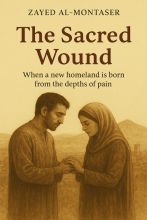
Osama and Rahaf, the novel's protagonists, are not merely two people who fall in love. They are symbols of every person who refuses to have their feelings imprisoned, of every heart that resists the laws of humanity that stifle human existence. They are a cry against oppressive customs and a beacon on the path to freedom for all who dare to love without fear.
And though I am one of the sons of sheikhs and one of the largest Yemeni tribes, my heart refuses to accept that people's souls should be divided by color, title, or lineage. My dignity is only complete when I see a human being as a human being, regardless of race or class. This novel was written in a style that blends the psychological depth of the inner narrator with the realistic social portrayal of the omniscient narrator, allowing hearts to see the pain, minds to contemplate injustice, and souls to touch the hope that springs forth from the ruins.
I ensured that the words were real and tangible, yet simultaneously poetic, so that the reader feels every glance, every touch, every word of love, rejection, and struggle, becoming part of the story, not merely a spectator of a fleeting scene.
Ultimately, this novel is an invitation to every besieged heart to find its courage, to every suppressed soul to beat with freedom, to every mind that witnesses injustice to reject it, and to every society that stifles love to open its window to humanity.
Here, pain is sacred, not because it is pain without cause, but because it transforms pain into a lesson, fear into courage, and prohibition into rebellion.
I hope that these words, these feelings, and these pages reach your heart, so that you may feel that love and freedom are more sublime than all constraints.
Zayed Al-Muntasir
𐩸𐩱𐩺𐩵 𐩱𐩡𐩣𐩬𐩩𐩮𐩧
Author's Note
Dear reader,
In a land where social standing varies like shadows on a single wall, stories are born from the womb of pain, and love becomes an adventure in the face of societal norms.
I grew up in a traditional tribal home, but I never believed that a person's worth is measured by title or lineage. What I truly believed was that injustice is universal, and that discrimination is a wound unworthy of a land that gives birth to dignity.
The novel "Sacred Pain" is not merely a story of impossible love, but a cry from a person whose heart confronts a society that distributes dignity like it distributes titles. In Yemen—where the mountains breathe pride and differences hide behind the cloak of tradition—people live in a world of merciless classifications: master, sheikh, barber, tribal, Hashemite, and simply a name.
In a land worn down by history, its people bequeathed a legacy of titles and constraints, stories are sometimes born from unseen pain. But behind those silent walls, there are hearts yearning for freedom, searching for their lost humanity, and believing that only love can break down these hierarchies.
Despite belonging to a large tribal family, I refuse to allow people to be categorized into classes, or for their status to be reduced to a color, a title, or a lineage. Life only flourishes when we break down the walls of discrimination and see each other through the eyes of justice.
When I began writing this novel, my aim wasn't simply to tell a conventional love story. My desire was deeper: to hold up a mirror to society and humanity, a mirror reflecting the true face of discrimination and classism, and revealing the price paid by hearts trapped between love and tradition, between freedom and social norms.
"Sacred Pain" is not just a title; it's a feeling that dwells in every heart that aches from the constraints of society, from the marginalization of individuals under the guise of blood and lineage, and from the rejection of love simply because it doesn't align with family plans or social classes.
Osama and Rahaf, the novel's protagonists, are not merely two people who fall in love. They are symbols of every person who refuses to have their feelings imprisoned, of every heart that resists the laws of humanity that stifle human existence. They are a cry against oppressive customs and a beacon on the path to freedom for all who dare to love without fear.
And though I am one of the sons of sheikhs and one of the largest Yemeni tribes, my heart refuses to accept that people's souls should be divided by color, title, or lineage. My dignity is only complete when I see a human being as a human being, regardless of race or class. This novel was written in a style that blends the psychological depth of the inner narrator with the realistic social portrayal of the omniscient narrator, allowing hearts to see the pain, minds to contemplate injustice, and souls to touch the hope that springs forth from the ruins.
I ensured that the words were real and tangible, yet simultaneously poetic, so that the reader feels every glance, every touch, every word of love, rejection, and struggle, becoming part of the story, not merely a spectator of a fleeting scene.
Ultimately, this novel is an invitation to every besieged heart to find its courage, to every suppressed soul to beat with freedom, to every mind that witnesses injustice to reject it, and to every society that stifles love to open its window to humanity.
Here, pain is sacred, not because it is pain without cause, but because it transforms pain into a lesson, fear into courage, and prohibition into rebellion.
I hope that these words, these feelings, and these pages reach your heart, so that you may feel that love and freedom are more sublime than all constraints.
Zayed Al-Muntasir
𐩸𐩱𐩺𐩵 𐩱𐩡𐩣𐩬𐩩𐩮𐩧
المزيد...